Ask most dentists what keeps them up at night, and the answer often has little to do with clinical skill. It is the overhead. It is the worry about whether enough patients will show up, whether treatment plans will be accepted, and whether there will be anything left to take home at the end of the month.
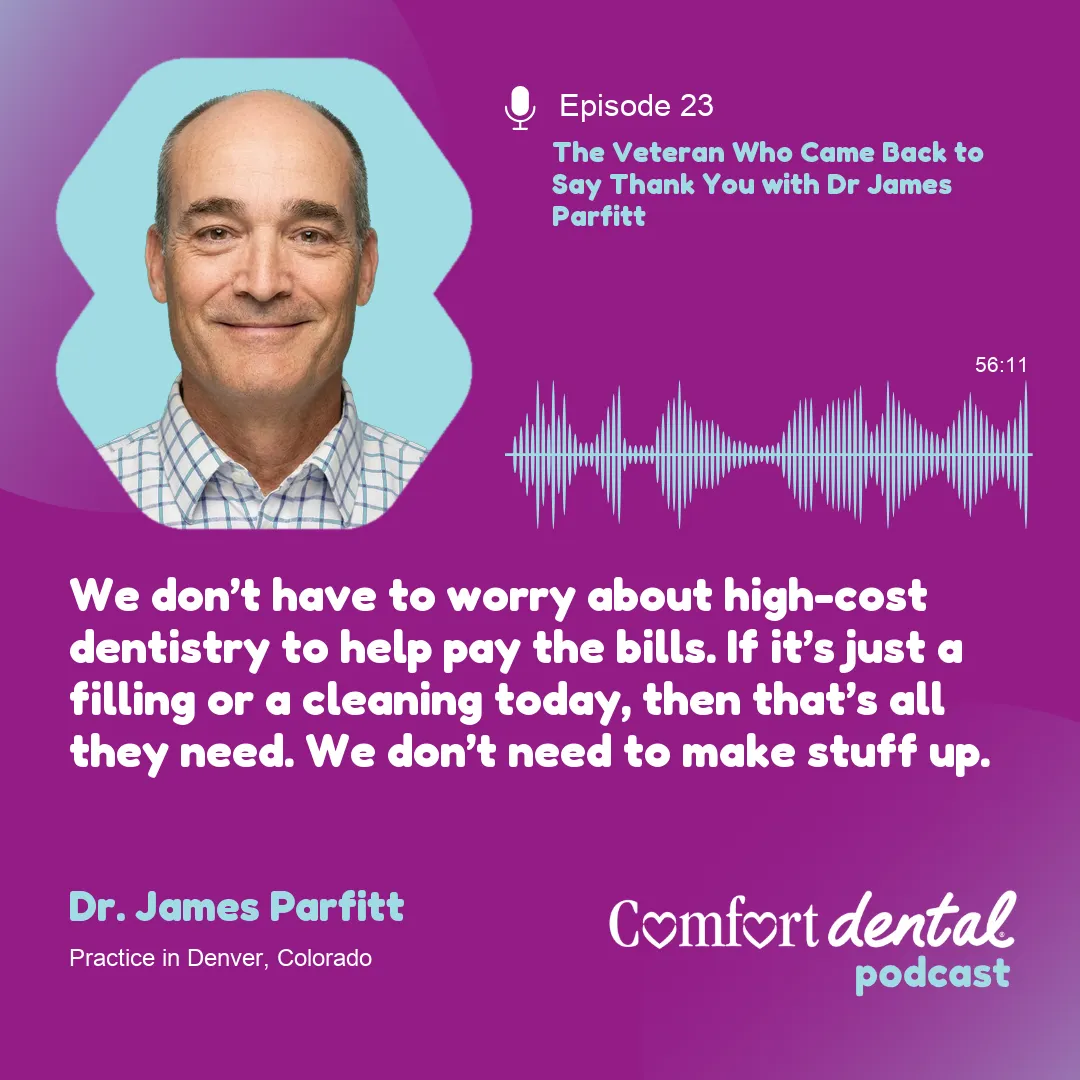
Dr. James Parfitt, a Comfort Dental partner for 24 years and the dentist at Comfort Dental Mile High in Denver, has rarely felt that pressure. In a recent podcast interview, he explained why that matters so much, not only for dentists but for patients.
"We don't have to worry about high-cost dentistry to help pay the bills. If it's just a filling or a cleaning today, then that's all they need. We don't need to make stuff up."
The Hidden Ethical Burden of Solo Practice
Many solo practitioners carry an uncomfortable weight. When margins are razor thin, every unaccepted treatment plan feels like a threat. Over time, that pressure can quietly influence clinical decisions.
Dr. Parfitt sees the contrast clearly when he talks with colleagues outside of Comfort Dental. One friend from his residency, practicing in Alabama, describes a daily grind to cover expenses. "He complains how hard a struggle it is on a daily basis to grind it out and how long in the month he has to work to pay his bills before he takes something home," Dr. Parfitt said. "I don't have his problems because I chose a different path."
Rethinking the Overhead Calendar
For many solo dentists, overhead is not covered until the last few days of the month. Dr. Parfitt's experience has been the opposite.
"Very few moments in my 24 years have I worried about not meeting our fixed overhead," he said. Instead, the conversation in his office sounds like this: "Can we have our overhead paid for on the 15th of the month this month? Maybe we can do it on the 13th. Wow, maybe it's gonna be the 10th."
Compare that with peers who tell him they work 28 days before their overhead is covered. That gap is the difference between practicing from scarcity and practicing from security.
Why the Partnership Model Works
Dr. Parfitt credits the Comfort Dental structure for that stability. Shared offices, shared staff, and controlled overhead create economies of scale that a single dentist simply cannot match.
Patient volume is another factor. "We're lucky enough with the patient volume because we don't really pick and choose who we wanna treat," he explained. "We just allow anybody who comes in and be happy to look after them."
There is also a practical limit to what one dentist can produce. "The amount of dentistry two hands can perform, there's only so much you could do," Dr. Parfitt noted. In solo practice, the dentist bears all the risk. In a partnership, that risk is shared, and so is the support.
Clinical Autonomy Without the Pressure
A common assumption about franchised dentistry is that doctors are told what to do and how to treat. Dr. Parfitt calls that a misnomer.
"Everyone has this misnomer that they're going to be policed," he said. "In my 24 years, I don't think I've ever had that conversation. Not even a second." When the support office does reach out, he explained, it is to coach and mentor, not to dictate.
That freedom, combined with financial stability, allows Comfort Dental dentists to practice the way they believe is right. "You can actually just kinda treat the patient and give what they're looking for and you do right by the patient," he said. "Everything
The content on this blog is not intended to be a substitute for professional medical advice, diagnosis, or treatment. Always seek the advice of qualified health providers with questions you may have regarding medical conditions.
Keep Reading